The Complete Guide to Paraphrasing: Techniques, Methods, Examples & Best Practices
- Published: Dec 01, 2025
- Last updated: Jun 30, 2026
- Calculating reading time...
Whether you're writing a university assignment, preparing a business report, creating website content, or explaining a complex idea, paraphrasing is one of the most valuable writing skills you can develop.
Many people assume paraphrasing simply means replacing a few words with synonyms. In reality, it involves expressing the same idea in a new way while preserving its original meaning. The goal is not to make content look different but to communicate information more clearly and appropriately for a specific audience.
In today's digital world, this skill is more valuable than ever. Students use it to demonstrate understanding, professionals rely on it to communicate complex ideas, and writers use it to create clear, engaging content without repeating the same language.
From my own experience writing SEO articles and long-form educational content, I've found that the strongest writers rarely focus on changing words. Instead, they first understand the message and then explain it naturally for the reader. For instance, a technical explanation intended for software engineers may require a rewrite for business executives. Although the core idea remains the same, the language, examples, and tone change completely.
Expert Tip
Strong paraphrasing starts before writing. I usually pause and mentally explain the idea in simple language first. This helps me naturally rewrite content without depending on vocabulary replacement.
In this guide, you'll learn what paraphrasing is, why it matters, the techniques professionals use, different types of paraphrasing, practical examples, and how to build stronger paraphrasing skills for academic, professional, and everyday communication.
Paraphrasing at a Glance
If you're looking for a quick overview, here's what you need to know before diving into the complete guide.
Paraphrasing means expressing an idea using different words while preserving its original meaning.
Effective paraphrasing changes both wording and sentence structure.
Strong paraphrasing improves clarity, learning, and communication.
Professional writers understand ideas before rewriting them.
AI tools can assist with paraphrasing, but human review remains essential.
Good paraphrasing adapts explanations to the intended audience.
Who Should Read This Guide?
This guide is helpful for anyone who needs to understand, explain, or restructure information in a clearer way. It is especially useful for:
Students trying to improve comprehension through rewriting
Professionals adapting communication for different audiences
Writers focusing on clarity and information restructuring
Learners demonstrating understanding in assignments
Content creators and bloggers improving readability
SEO writers building clearer and more helpful content
Educators simplifying complex ideas for students
Anyone working with AI writing tools
Paraphrasing is not just a writing technique—it is a core communication skill used across academic, professional, and digital environments.
What Is Paraphrasing?
At its core, paraphrasing is the process of expressing an idea, message, or piece of information in different words while preserving its original meaning.
Unlike copying, which repeats the original wording, paraphrasing changes the wording, sentence structure, and style without changing the underlying message. It allows information to be presented more clearly, more naturally, or in a way that better suits a particular audience.
For academic writing, APA's guidance on paraphrasing explains when paraphrasing should still be accompanied by proper citation and source acknowledgment.
Example
Original
"Regular physical activity contributes significantly to long-term cardiovascular health."
Paraphrased
"Exercising consistently helps keep your heart healthy over time."
Although the wording has changed, both sentences communicate exactly the same idea.
A simple way to understand the difference is
Copying repeats words.
Summarizing reduces information.
Paraphrasing reshapes the explanation while keeping the meaning intact.
Paraphrasing appears in everyday communication more often than many people realize. Teachers explain textbook concepts in simpler language, managers restate meeting discussions for their teams, and writers adapt technical information for readers with different levels of knowledge.
Throughout this guide, you'll see how paraphrasing extends far beyond writing assignments and becomes an essential communication skill in both professional and everyday situations.
Why Paraphrasing Is an Essential Writing Skill
Many people associate paraphrasing with school assignments, but its value extends far beyond education.
It is a practical communication skill that helps people explain ideas clearly, improve understanding, and adapt information for different audiences.
Every audience has different levels of knowledge and different expectations. A technical explanation that works well for an engineer may confuse a business executive or a beginner. By adjusting the language while preserving the original meaning, writers make information more accessible without sacrificing accuracy.
For example, imagine a software developer explaining a cybersecurity issue to a company director. Instead of focusing on technical terminology, they might describe the business risks and practical impact. The information stays the same, but the explanation becomes much easier for the audience to understand.
Paraphrasing also strengthens learning. Explaining information in your words is often a better test of understanding than simply rereading or memorizing it. This is why teachers frequently ask students to restate concepts instead of repeating textbook definitions.
From a writing perspective, paraphrasing improves readability by reducing repetition and helping ideas flow naturally. It also allows writers to adapt the same information for different formats, audiences, and communication goals.
Whether you're creating articles, reports, presentations, or educational material, effective paraphrasing helps bridge the gap between information and understanding.
The Psychology Behind Effective Paraphrasing
Why do some paraphrases sound natural while others feel forced?
The answer has less to do with vocabulary and more to do with how the brain processes ideas.
Effective paraphrasing is a cognitive process—not simply a vocabulary exercise. It requires the brain to interpret ideas, organize information, and reconstruct them into a new explanation while preserving the original meaning.
When people copy text word for word, they often focus on individual words instead of the underlying concept. Effective paraphrasing encourages deeper thinking. Writers must process information, identify relationships between ideas, and reorganize them into a clearer explanation.
Educational researchers often describe this as active learning. Instead of passively reading information, learners engage with it by analyzing, organizing, and explaining concepts in their words. This deeper level of mental processing strengthens comprehension, improves long-term memory, and makes it easier to recall information later.
Consider a student studying climate change. If they copy a paragraph directly into their notes, they may recognize the wording during an exam but struggle to explain the concept independently. If they read the material, close the book, and then describe the idea from memory, their brain actively reconstructs the information. That additional mental effort helps strengthen both understanding and retention.
The same principle applies in professional writing. Experienced writers rely on active mental processing to organize ideas before expressing them in a clearer structure. By analyzing relationships between concepts and reorganizing information, they create explanations that are clearer, more logical, and easier for readers to follow.
Another psychological benefit of active processing is audience adaptation. Once writers understand how ideas connect, they can reorganize those ideas for different readers without changing the original meaning. Explaining a scientific concept to another scientist requires a different language than explaining it to a child. This flexibility reflects genuine conceptual understanding rather than simple memorization.
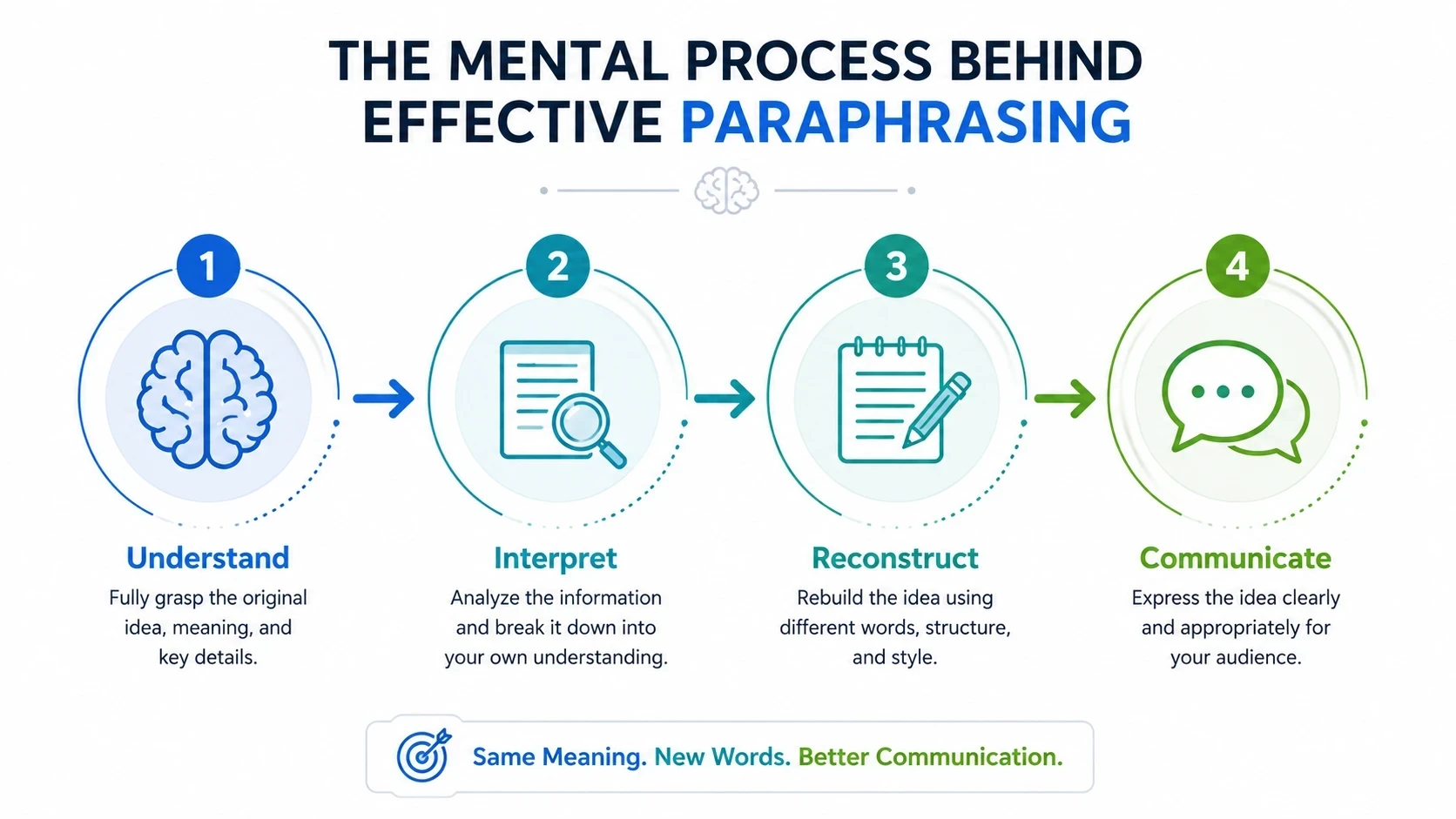
A useful way to visualize the process is the following:
Understand → Interpret → Reconstruct → Communicate
Each stage builds on the previous one. As the brain interprets, organizes, and reconstructs information, comprehension becomes deeper, memory becomes stronger, and communication becomes more natural. Effective paraphrasing is a result of this active mental process rather than simple word replacement.
In Simple Terms
Your brain understands writing better when it actively explains ideas instead of copying them. When you break down a concept and rebuild it in your own words, you improve understanding, memory, and clarity at the same time.
Key Insights
Understanding comes before rewriting.
Active thinking improves comprehension and memory.
Strong paraphrases rebuild ideas—not just words.
Audience awareness improves communication.
The U.N.D.E.R.S.T.A.N.D. Framework
This framework reflects how people naturally process information—from understanding ideas to organizing and communicating them effectively. Following this sequence reduces cognitive overload, improves recall, and helps writers produce clearer, more accurate explanations.
Expert Tip
Strong paraphrasing always starts with mental processing, not rewriting. When working on complex topics, it helps to first explain the idea in simple language before writing anything down. This small step usually leads to clearer, more natural, and more accurate content.
The 5 Levels of Paraphrasing
Not all paraphrasing requires the same level of skill. Some approaches simply change wording, while others require a deep understanding of the topic and the audience.
In practice, most examples of paraphrasing fall into five levels. Understanding them can help you move beyond basic rewriting and develop stronger communication skills.
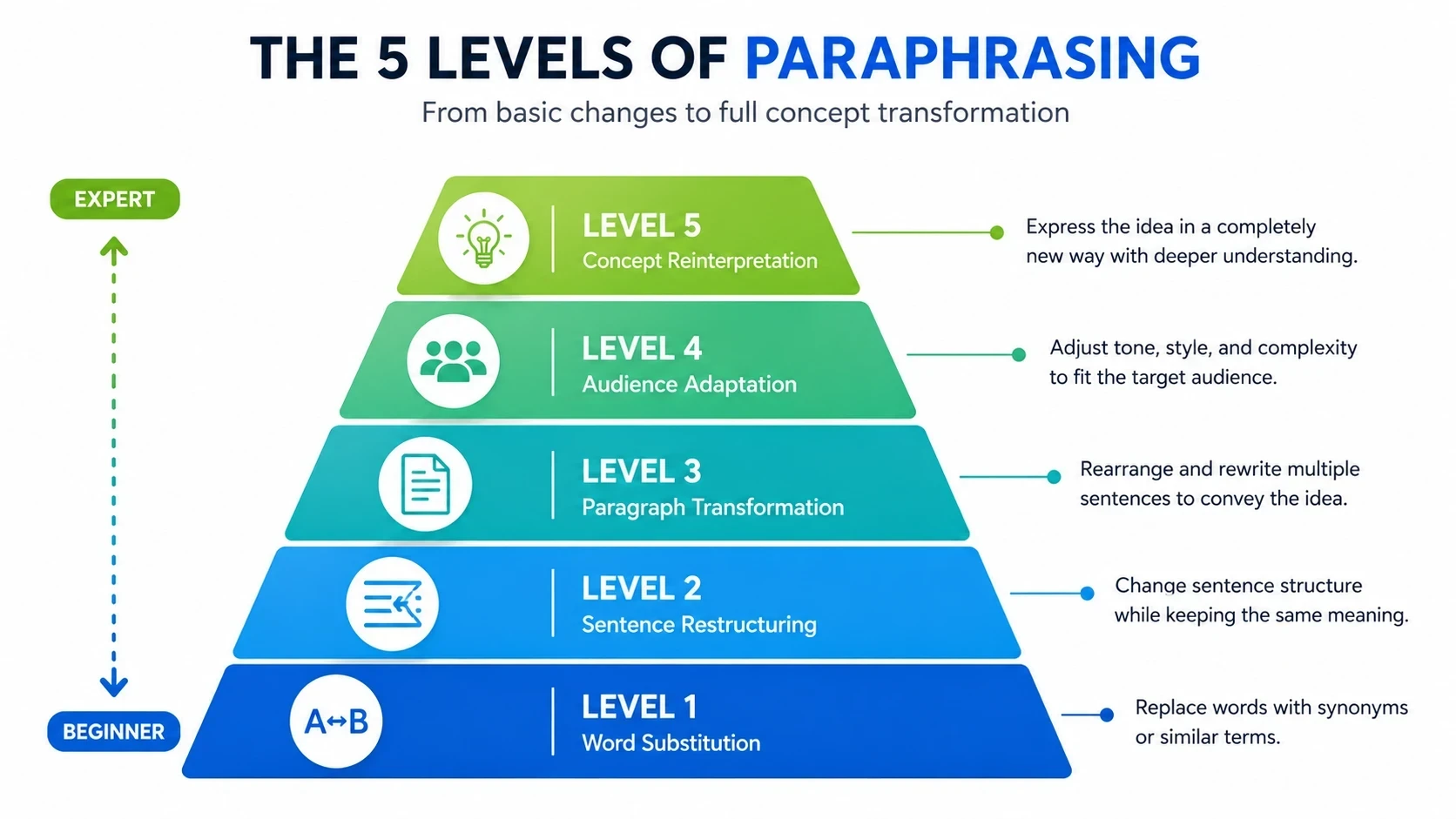
Level 1: Word Substitution
This is the simplest form of paraphrasing. Individual words are replaced with synonyms, but the sentence structure remains almost unchanged.
Before
Customer satisfaction is important for business success.
After
Client satisfaction is essential for business success.
Although a few words have changed, the sentence is still very similar to the original. This level is useful for minor edits but rarely demonstrates genuine understanding.
Level 2: Sentence Restructuring
Here, the wording and sentence structure both change while the original meaning stays the same.
Before
Customer satisfaction is important for business success.
After
Businesses are more likely to succeed when customers are satisfied with their experience.
This approach produces a more natural rewrite and is commonly used in professional writing.
Level 3: Paragraph Transformation
Instead of rewriting individual sentences, this level focuses on reorganizing an entire idea into a new paragraph.
Before
Customer satisfaction contributes to loyalty, repeat purchases, and positive recommendations.
After
Positive customer experiences encourage repeat business, strengthen loyalty, and increase the likelihood of recommendations.
Because the information is reorganized rather than lightly rewritten, this level is common in academic, business, and SEO writing.
Level 4: Audience Adaptation
Professional writers rarely explain information the same way to every reader. Instead, they adapt the message to match the audience's knowledge and needs.
Consider this statement:
Original
Natural Language Processing enables machines to interpret and generate human language.
For software engineers
NLP enables systems to process linguistic data and generate context-aware responses.
For business leaders
NLP helps businesses automate communication and improve customer interactions.
For students
NLP is the technology that helps computers understand and respond to human language.
The idea remains identical, but the explanation changes depending on who is reading it.
Level 5: Concept Reinterpretation
This is the highest level of paraphrasing.
Instead of simply rewriting information, the writer explains the same idea through a fresh perspective, analogy, or example.
Original Concept
Learning becomes more effective when people actively engage with information.
Paraphrase
Learning is like exercise. Watching someone else lift weights won't build your strength. Likewise, simply reading information rarely creates lasting knowledge. Real understanding develops when you actively work with ideas.
This level is common in expert teaching, thought leadership, and high-quality educational content because it makes complex ideas easier to understand and remember.
Comparison of the Five Levels
Which Level Should You Aim For?
Most effective paraphrasing happens at Levels 3–5, where writers reorganize ideas and adapt them for different audiences instead of simply changing words. As your skills improve, your focus naturally shifts from replacing vocabulary to improving communication.
Common Misconceptions About Paraphrasing
Ready to Put These Techniques into Practice?
Apply what you've learned with our free paraphrasing tool. Rewrite text clearly, naturally, and confidently while preserving the original meaning.
Try the Free Paraphrasing Tool
Different Types of Paraphrasing
Have you ever wondered why the same idea is explained differently in a university textbook, a business presentation, and a blog post?
The reason is simple: different situations require different types of paraphrasing. The best approach depends on your purpose, your audience, and the type of information you're communicating.
That's why professional writers don't rely on a single method. Instead, they adapt their writing style to fit the reader and the context.
Below are the most common types of paraphrasing used in academic, professional, and digital communication.
Academic Paraphrasing
Academic writing prioritizes accuracy, clarity, and proper attribution. Students and researchers paraphrase published sources to demonstrate understanding while avoiding unnecessary quotation.
Original Version
Regular physical activity has been associated with improved cardiovascular health outcomes.
Paraphrased Version
Studies suggest that consistent exercise contributes to better heart health and overall cardiovascular function.
The wording changes, but the original meaning remains accurate.
Business Paraphrasing
Business communication often requires the same information to be explained differently for executives, clients, employees, or stakeholders.
Original Version
The implementation timeline has been extended due to resource constraints.
Paraphrased Version
The project schedule has been adjusted because additional resources are needed to complete the work effectively.
The goal is clear communication rather than technical precision.
Technical Paraphrasing
Technical subjects frequently contain specialist terminology that can overwhelm general readers.
Original Version
The application utilizes distributed cloud architecture to improve scalability and fault tolerance.
Paraphrased Version
The system uses multiple cloud-based resources so it can handle increased demand while reducing service interruptions.
The explanation becomes easier to understand without changing the core idea.
Marketing Paraphrasing
Marketing content is adapted to improve engagement across different platforms while keeping the main message consistent.
Original Version
Our software helps teams collaborate more efficiently.
Paraphrased Version
Bring your team together, simplify communication, and accomplish more with less effort.
Here, the focus shifts from explanation to audience engagement.
SEO Paraphrasing
What makes SEO paraphrasing different from ordinary rewriting?
SEO paraphrasing is not just about changing words — it is about creating genuinely helpful content that combines information from multiple sources, improves clarity, and delivers more value to readers.
Effective SEO writing is not about replacing words to avoid duplicate content. It is about creating clearer explanations, adding original insights, and improving the reader's experience.
From my experience writing long-form SEO content, the strongest-performing articles come from understanding several trusted sources and explaining the topic in a way that's more practical and easier to follow—not from rewriting a single article.
Expert Tip
In SEO writing, paraphrasing is not about avoiding duplication — it’s about adding clarity and usefulness. The best-performing content usually comes from explaining ideas in a more helpful way, not just rewriting them differently.
Educational Paraphrasing
Teachers and trainers frequently paraphrase complex ideas to make learning easier.
Original Version
Photosynthesis converts light energy into chemical energy stored within glucose molecules.
Paraphrased Version
Plants use sunlight to produce food that gives them the energy they need to grow.
The objective is to improve understanding while preserving accuracy.
Quick Comparison
Which Type Should You Use?
The right type of paraphrasing depends on your audience and your goal.
A university professor, business executive, software engineer, and school student may all need the same information explained differently. Effective writers don't simply rewrite text—they adapt it to match the reader's level of knowledge and expectations.
Before you begin paraphrasing, ask yourself one question:
Who am I writing for?
That single decision often determines which approach will produce the clearest and most effective result.
Paraphrasing Techniques Used by Professional Writers
Many beginners believe effective paraphrasing comes from having a large vocabulary. In reality, professional writers rely on structured writing techniques rather than simply replacing words with synonyms.
These methods help preserve the original meaning while making content clearer, more engaging, and better suited to the intended audience.
1. Sentence Inversion
Sentence inversion changes the order of information without changing the meaning.
Original
Effective communication improves workplace productivity.
Paraphrased
Workplace productivity often improves when communication is effective.
Although the structure changes, the message remains the same. This is one of the simplest ways to create a natural paraphrase.
2. Switching Between Active and Passive Voice
Changing the sentence voice can significantly alter structure while preserving meaning.
Active to Passive
Original
The company launched a new customer support platform.
Paraphrased
A new customer support platform was launched by the company.
Passive to Active
Original
The report was prepared by the project team.
Paraphrased
The project team prepared the report.
Active voice is generally clearer and more engaging, while passive voice can be useful when the action is more important than the subject. Skilled writers use both where appropriate.
3. Combining or Splitting Sentences
Sometimes several short sentences can be merged into one smoother explanation.
Original
The software is easy to use. It includes collaboration features. It supports remote teams.
Paraphrased
The software combines ease of use with collaboration tools that help remote teams work more effectively.
The opposite approach also improves readability.
Original
The organization implemented a new communication platform that improved collaboration across departments while reducing project delays and increasing operational efficiency.
Paraphrased
The organization introduced a new communication platform. As a result, departments collaborated more effectively, project delays decreased, and overall efficiency improved.
Breaking long sentences into shorter ones often makes information easier to scan, especially on mobile devices.
4. Expanding Definitions
Professional writers often expand brief statements into clearer explanations when introducing new concepts.
Original
Cybersecurity protects digital systems.
Expanded Paraphrase
Cybersecurity includes the practices, technologies, and processes used to protect digital systems, networks, and sensitive information from cyber threats.
This technique is particularly useful in educational and technical writing.
5. Replacing Abstract Ideas with Examples
Examples often communicate ideas more effectively than definitions alone.
Original
Flexible working arrangements can improve employee satisfaction.
Paraphrased
Options such as remote work, hybrid schedules, and flexible hours help many employees achieve a better work-life balance.
Adding practical examples makes information more relatable without changing its meaning.
Paraphrasing Examples Across Different Industries
Paraphrasing follows the same core principle in every field—preserving meaning while changing the presentation. What changes is the audience and the purpose.
The examples below show how the same skill is applied across different industries.
Academic Writing
Academic paraphrasing focuses on accuracy while presenting research in the original language.
Original Version
Research indicates that regular physical activity contributes significantly to improved mental well-being.
Rewritten Version
Studies suggest that consistent exercise plays an important role in supporting mental health and emotional wellness.
This style is commonly used in essays, research papers, and literature reviews.
Healthcare
Healthcare professionals often translate medical terminology into language patients can easily understand.
Original Version
Hypertension increases the likelihood of cardiovascular complications if left unmanaged.
Rewritten Version
High blood pressure can increase the risk of heart-related health problems if it isn't properly controlled.
The medical meaning stays accurate while becoming more accessible.
Business Communication
Business writing often simplifies formal language for employees, clients, or stakeholders.
Original Version
The organization will implement operational improvements to enhance productivity.
Rewritten Version
The company plans to introduce new processes that help employees work more efficiently.
The message becomes more direct without losing meaning.
Marketing
Marketing paraphrasing focuses on benefits rather than technical descriptions.
Original Version
Our platform streamlines project management processes.
Rewritten Version
Manage projects more easily, stay organized, and keep your team aligned from start to finish.
Rather than describing the product, the rewrite highlights the value it provides.
Blogging
Blog articles often simplify technical information for everyday readers.
Original Version
Search engines evaluate content quality using multiple relevance and usefulness signals.
Rewritten Version
Search engines consider several factors to decide whether a page provides helpful information for users.
This approach improves readability without sacrificing accuracy.
Journalism
Journalists frequently paraphrase interviews, reports, and official statements while preserving factual accuracy.
Original Version
The spokesperson stated that additional measures would be introduced to improve public safety.
Rewritten Version
According to the spokesperson, new initiatives are planned to strengthen public safety.
The wording changes, but the information remains faithful to the original statement.
One Message, Different Audiences
The same idea can be presented differently depending on who is reading it.
Original Concept
Remote work can improve employee flexibility.
Although the wording changes, the central idea remains the same. The audience—not the concept—drives the rewrite.
Strong paraphrasing isn't measured by how different the wording looks from the original. It's measured by how accurately the message is preserved and how well it meets the needs of the intended audience. Rather than simply rewriting sentences, professional writers adapt information so readers can understand it more easily.
Manual vs. AI Paraphrasing
Should you paraphrase manually or let AI do the work?
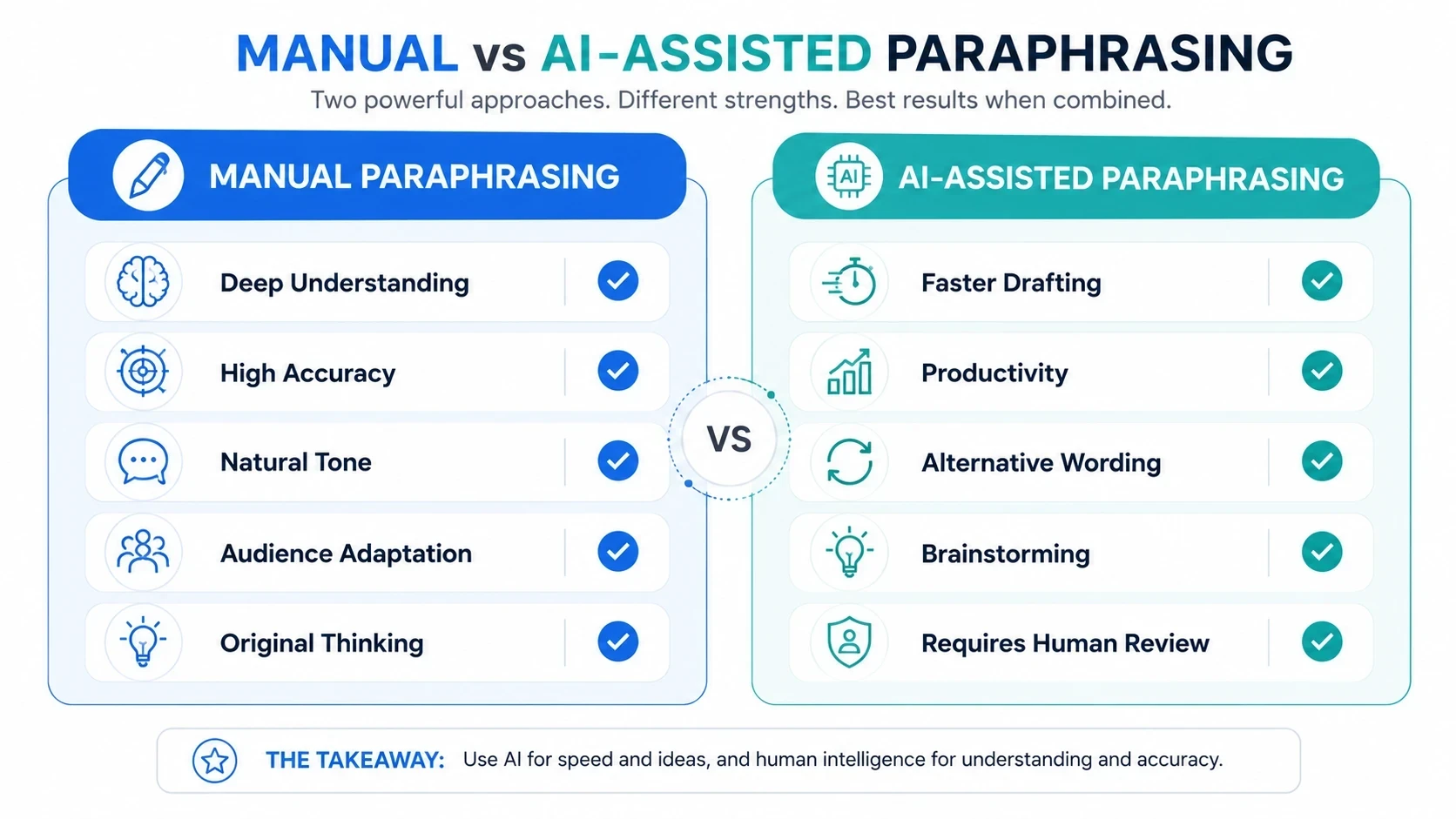
The answer depends on your goal. Each approach has strengths, and many professional writers combine both rather than relying entirely on one method.
Manual Paraphrasing
Manual paraphrasing involves reading the original material, understanding its meaning, and rewriting it in your own words. Because the process relies on human comprehension, it is often the best choice when accuracy, tone, and audience adaptation matter.
Advantages
Encourages deeper understanding of the source material
Produces more natural, audience-focused writing
Allows better control over tone, context, and style
Often results in stronger originality
Limitations
Takes more time
Requires subject knowledge
Can be challenging for inexperienced writers
AI-Assisted Paraphrasing
AI paraphrasing tools generate alternative versions of text within seconds, making them useful for brainstorming ideas or creating first drafts. However, they should be viewed as writing assistants rather than complete replacements for human judgment.
Advantages
Produces drafts quickly
Suggests alternative sentence structures
Helps overcome writer's block
Improves productivity for repetitive tasks
Limitations
May misunderstand context or nuance
Can generate generic or repetitive wording
Requires careful fact-checking and editing
May not fully match the intended audience or tone
Manual vs. AI Comparison
Which Approach Is Better?
For most professional projects, the strongest workflow combines both methods. AI can generate a starting point or suggest alternative phrasing, while the writer reviews the content for clarity, accuracy, and audience fit.
If you're writing academic work, legal content, technical documentation, or anything where precision matters, manual review remains essential. AI can save time, but it should support the writing process—not replace thoughtful editing.
Key takeaway: AI is most valuable as a productivity tool, while human writers remain responsible for judgment, accuracy, tone, and final quality.
Expert Tip
The best workflow is hybrid: use AI for speed, but rely on human judgment for accuracy, tone, and audience alignment. This combination consistently produces the strongest results.
How AI Paraphrasing Works
So what actually happens after you paste a paragraph into an AI paraphrasing tool?
Instead of simply replacing words with synonyms, modern AI systems analyze sentence structure, context, and language patterns to generate alternative versions that preserve the original meaning while changing the wording.
Most advanced systems rely on three core technologies:
Natural Language Processing (NLP)
Natural Language Processing (NLP) enables computers to analyze grammar, sentence structure, and relationships between words. This helps AI recognize how ideas connect instead of treating each word separately.
Machine Learning
Machine learning allows AI systems to improve by learning from large collections of text. Rather than following fixed rewriting rules, the models identify language patterns that help generate more natural alternatives.
Large Language Models (LLMs)
Large Language Models (LLMs) are trained on enormous amounts of written content. They predict the most appropriate way to express an idea based on context, making modern AI outputs far more fluent than earlier rewriting tools.
Modern AI systems also rely on concepts such as semantic similarity, context understanding, knowledge representation, and information retrieval to generate more accurate paraphrases, although human review remains essential.
A Simple Example
Original
Effective communication improves workplace productivity.
AI-generated paraphrase
Clear communication helps teams collaborate more effectively and achieve better results.
The wording changes while the central idea remains the same.
AI tools don't truly understand meaning like humans. Instead, they predict the best way to rewrite a sentence based on patterns they've learned from large amounts of text. That's why human review is always needed.
Although modern AI systems can generate highly fluent paraphrases, they do so by predicting language patterns rather than reasoning about ideas in the same way humans do. This enables AI to produce natural-sounding rewrites quickly, but it can also cause them to overlook context, subtle meaning, or specialized knowledge.
Understanding how these technologies work helps writers use AI more effectively by recognizing both their strengths and their limitations.
How to Build a Personal Paraphrasing Workflow
Effective paraphrasing is rarely a one-step task. Experienced writers follow a structured workflow that improves consistency, preserves meaning, and produces clearer, more reliable writing.
A repeatable workflow is especially useful when working with technical, academic, or research-based content, where accuracy matters as much as readability.
The R.E.V.I.S.E. Workflow
A simple process can make paraphrasing more efficient without adding unnecessary complexity.
Why This Process Works
Following the same workflow consistently helps reduce common writing problems, including:
Missing important information
Misinterpreting the original meaning
Creating awkward or inconsistent wording
Spending extra time on unnecessary revisions
Instead of relying on inspiration, professional writers rely on a process that produces reliable results.
One Common Mistake
Many beginners follow an inconsistent writing process, which often leads to unnecessary revisions, awkward wording, and uneven results. Following a structured workflow keeps each stage focused, improves consistency, reduces editing time, and helps produce clearer, more reliable paraphrases across different types of content.
Paraphrasing Challenges Beginners Face
Every writer encounters difficulties when learning to paraphrase. The good news is that most beginner mistakes are predictable—and with practice, they become much easier to overcome.
Common Challenges and Solutions
Practical Example
Original
Customer loyalty contributes to long-term business growth.
Weak rewrite
Client loyalty contributes to long-term company growth.
Improved rewrite
Businesses that build lasting customer relationships are more likely to achieve sustainable growth over time.
The second version communicates the same idea while using a different structure and more natural language.
Many of these challenges are explored in greater detail in our Common Paraphrasing Mistakes guide, where you'll find practical examples and step-by-step solutions.
As you continue practicing these techniques, you'll find that most beginner mistakes become much easier to avoid. Focusing on understanding ideas rather than simply changing words will help you produce paraphrases that are clearer, more natural, and more original.
Paraphrasing and Academic Integrity
In education, paraphrasing is more than a writing technique—it's a way to demonstrate understanding. Universities encourage students to explain ideas in their words because doing so shows they have processed the information rather than simply copied it.
Why Academic Integrity Matters
Academic integrity is built on a few core principles:
Honesty
Fair attribution
Respect for intellectual property
Responsible use of sources
Following these principles helps maintain both credibility and ethical scholarship.
How Paraphrasing Supports Learning
When students paraphrase effectively, they must:
Understand the source material
Identify the main ideas
Organize information logically
Express concepts clearly in their own words
This active process strengthens comprehension far more than copying text directly.
Best Practices
To paraphrase responsibly in academic work:
Read the original source carefully before rewriting.
Take notes instead of copying sentences.
Keep your ideas separate from sourced information.
Cite sources whenever required by your institution.
Review your university's academic integrity guidelines.
Learn More
Academic integrity involves more than paraphrasing alone. If you want practical examples of proper source use, citations, and originality, see our detailed guide on How to Avoid Plagiarism.
Effective paraphrasing demonstrates understanding, while academic integrity ensures that knowledge is communicated honestly and responsibly.
Following best practices for proper citation and attribution helps acknowledge original authors while strengthening the credibility of your own writing.
Paraphrasing and Legal Considerations
For most writers, students, and professionals, paraphrasing is a normal and legitimate part of communication. However, certain situations require extra care to ensure information remains accurate and responsibly presented.
When Extra Attention Is Needed
Some types of content are less forgiving because even small wording changes can affect meaning.
Accuracy Comes First
Changing the wording is never the primary goal. A successful paraphrase preserves the original meaning while making the information clearer for the intended audience.
Before publishing, ask yourself:
Is the information still accurate?
Could a reader misunderstand the explanation?
Does the rewritten version faithfully represent the original idea?
If the answer is yes, the paraphrase is doing its job.
Learn More
Questions about plagiarism, copyright, and responsible rewriting deserve a deeper discussion than this pillar can provide. Our guide: Can You Get in Trouble for Paraphrasing? explores common misconceptions and real-world examples in detail.
Most problems arise from changing the meaning—not from paraphrasing itself. Prioritizing accuracy and responsible source use keeps your writing both useful and trustworthy.
Paraphrasing vs. Other Writing Methods
Paraphrasing is often confused with summarizing, quoting, and rewriting. Although these techniques are related, they serve different purposes.
Quick Comparison
Paraphrasing vs. Summarizing
The biggest difference is the amount of detail.
Paraphrasing keeps the original meaning and most of the supporting information while changing the wording and structure.
Summarizing removes supporting details and focuses only on the main points.
Paraphrasing vs. Quoting
Quoting reproduces a source word for word, making it useful when the exact language is important.
Paraphrasing communicates the same idea in your own words, improving readability or adapting the information for a different audience.
Paraphrasing vs. Rewriting
Rewriting is a broader editing process that may involve changing tone, structure, length, or style.
Paraphrasing has a narrower purpose: expressing the same idea differently while preserving its original meaning.
Which Method Should You Use?
Choose:
Paraphrasing when you want to explain an idea more clearly without losing detail.
Summarizing when brevity is the priority.
Quoting when the original wording is especially important.
Rewriting when improving or adapting existing content.
For a more detailed comparison with examples, see our guide Paraphrasing vs. Summarizing.
Understanding when to paraphrase, summarize, quote, or rewrite helps you communicate ideas more clearly and choose the most effective approach for every writing situation.
TL;DR
Paraphrasing = same meaning, different wording
Summarizing = shorter version of idea
Quoting = exact original words
Rewriting = improving or adjusting content style
Always match the method with the purpose.
Understanding comes before rewriting.
AI helps with drafting, but human review ensures quality.
When Should You Paraphrase?
Use paraphrasing when you want to:
✔ Explain an idea more clearly
✔ Adapt content for a different audience
✔ Improve readability
✔ Show understanding of a concept
✔ Rewrite research in your own words
Avoid paraphrasing when:
✘ Exact wording must remain unchanged.
✘ Legal text requires precision.
✘ Historical quotes must stay accurate.
✘ You are citing speeches or official statements.
FAQs
Paraphrasing is the process of expressing someone else's ideas in your own words while keeping the original meaning unchanged. Unlike copying, effective paraphrasing changes both the wording and sentence structure to communicate the same message more clearly and naturally.
Paraphrasing is important because it improves understanding, strengthens communication, and helps explain ideas for different audiences. It is widely used in education, business, content writing, research, and everyday communication to present information clearly without relying on the original wording.
Paraphrasing explains the same idea using different words while keeping a similar level of detail. Summarizing shortens the original content by focusing only on the main points. If you'd like a deeper comparison with examples, read our Paraphrasing vs. Summarizing guide.
AI can generate useful paraphrased content quickly, but it may miss context, nuance, or subject-specific meaning. For the best results, review AI-generated text to ensure it remains accurate, natural, and appropriate for your intended audience.
Improve your paraphrasing by reading regularly, practicing different sentence structures, rewriting from memory, reviewing your drafts, and adapting explanations for different audiences. Consistent practice helps you communicate ideas more naturally while maintaining accuracy.
A strong paraphrase preserves the original meaning while introducing fresh sentence structures, natural wording, logical flow, and language that matches the intended audience. The result should read like an original explanation rather than a rewritten sentence.
The most common mistakes include staying too close to the original wording, replacing only a few words with synonyms, misunderstanding the source, and changing the intended meaning. Overusing AI tools without reviewing the output can also reduce clarity and accuracy.
We cover these issues in more detail, along with practical solutions and examples, in our Common Paraphrasing Mistakes guide.
Not always. While paraphrasing helps create original wording, academic and professional writing often still requires proper citation when ideas come from another source. Changing the wording does not automatically remove the need to acknowledge the original author.
If you're writing essays, research papers, or professional documents, see our complete guide on How to Avoid Plagiarism for best practices, examples, and common misconceptions.
Conclusion
Paraphrasing is more than changing words—it's the ability to understand an idea and communicate it clearly in a way that suits a new audience while preserving its original meaning.
Whether you're a student, researcher, content writer, marketer, or business professional, strong paraphrasing skills help you explain information more effectively, improve readability, and adapt ideas for different audiences. As you've seen throughout this guide, effective paraphrasing combines active thinking, thoughtful restructuring, and audience awareness to communicate ideas accurately, clearly, and naturally.
While AI tools can speed up the writing process, human judgment remains essential for maintaining accuracy, clarity, and context. The most effective approach is to use technology as a support tool while relying on your own judgment to produce clear, reliable, and audience-focused communication.
If you'd like to continue learning, explore our related guides on Paraphrasing vs Summarizing, How to Avoid Plagiarism, Common Paraphrasing Mistakes, and Can You Get in Trouble for Paraphrasing? Each guide explores a specific aspect of paraphrasing with practical examples and actionable advice.
Ultimately, the goal of effective paraphrasing is not to make content look different—it is to communicate ideas accurately, clearly, and in a way that best serves the needs of the audience. When writers focus on meaning, organization, and communication rather than simple word replacement, paraphrasing becomes a skill that strengthens learning, improves writing, and helps people share knowledge more effectively across academic, professional, and everyday contexts.
Start Writing Clearer, More Original Content
Put these paraphrasing techniques into action with our free tool. Create clear, natural, and plagiarism-free content in just a few clicks.
Related Concepts
Readers exploring paraphrasing often also learn about:
Critical thinking
Active learning
Reading comprehension
Knowledge retention
Summarizing
Academic writing
Citation practices
Research skills
SEO writing
Information literacy
Prompt engineering
AI writing tools