Complete Guide to Age Calculation: How Exact Age Is Determined in Years, Months & Days
- Published: Dec 09, 2025
- Last updated: Jun 15, 2026
- Calculating reading time...
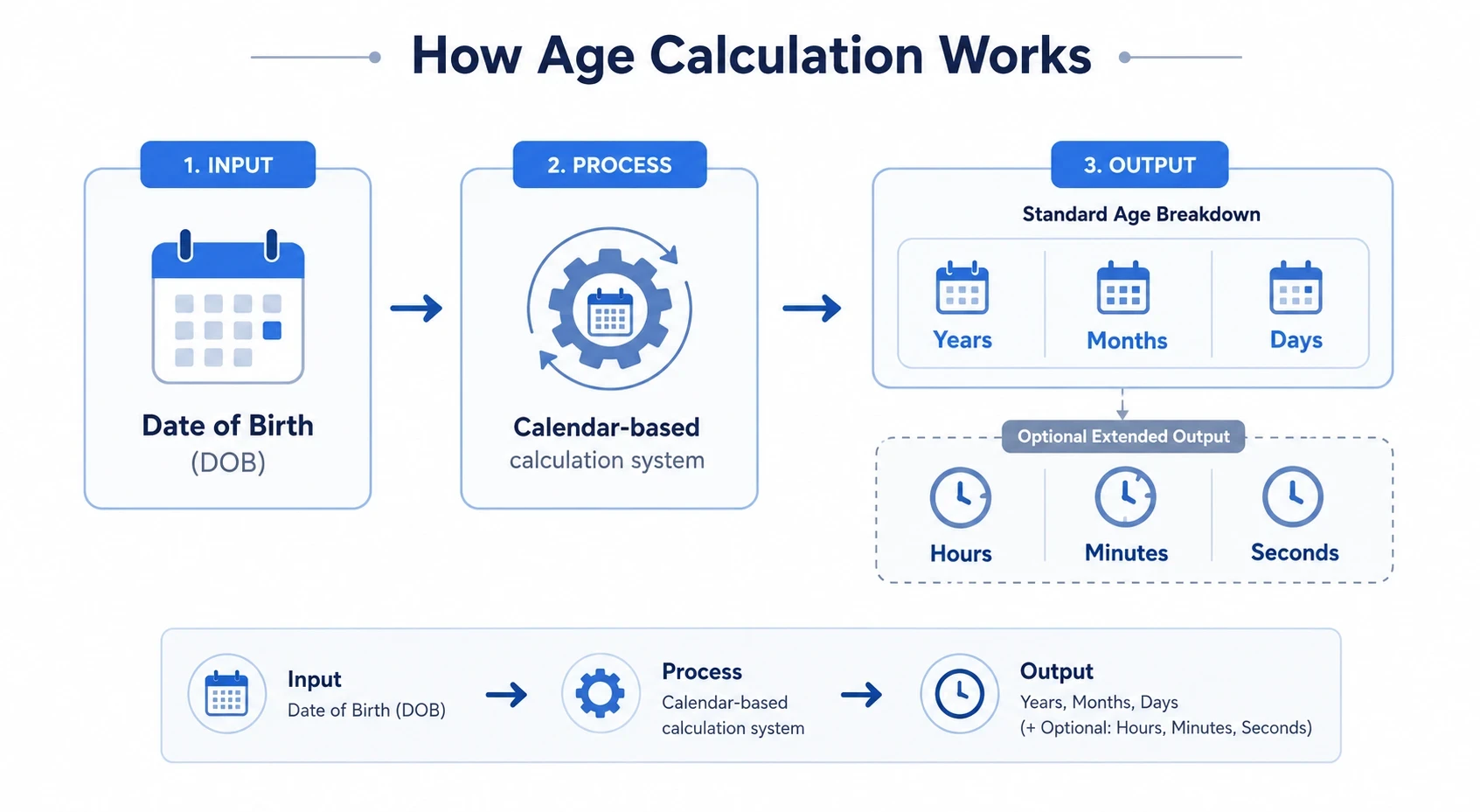
At first glance, age calculation feels simple—you enter your date of birth, and a number appears on the screen. But when you look a little deeper, it’s not just the basic subtraction behind that result.
What seems straightforward is actually based on calendar rules and how systems interpret time. Most people assume age is calculated directly, but it works in a more structured way.
Your exact age is not only the total years lived. It is a breakdown of years, months, and days—and in some systems, even hours and seconds are considered.
Different calculators can also show slightly different results. This doesn’t mean there is an error — it usually depends on how leap years, time zones, and date-handling rules are interpreted.
In this guide, you’ll understand how age is actually calculated and why those differences appear.
What Exact Age Calculation Really Means
Exact age calculation refers to measuring the precise time difference between two dates.
Your date of birth (DOB)
A reference date (usually today)
This difference is expressed as years, months, and days — but in real systems, the result is not just a neat breakdown. It is a reconstruction of time that depends on how a system “decides” a month has ended.
In advanced systems, it can also include:
Hours
Minutes
Seconds
But here’s something most people don’t think about—age calculation is not about “counting time forward"; it is about comparing completed time cycles.
This matters because time is not uniform:
Months do not have equal lengths.
February behaves differently in leap years.
Some years contain 366 days instead of 365.
That’s usually where confusion starts—because two systems may interpret the same dates using slightly different rules.
How Age Is Generally Calculated
At a surface level, age calculation seems simple — almost too simple. And this is exactly where mistakes usually begin.
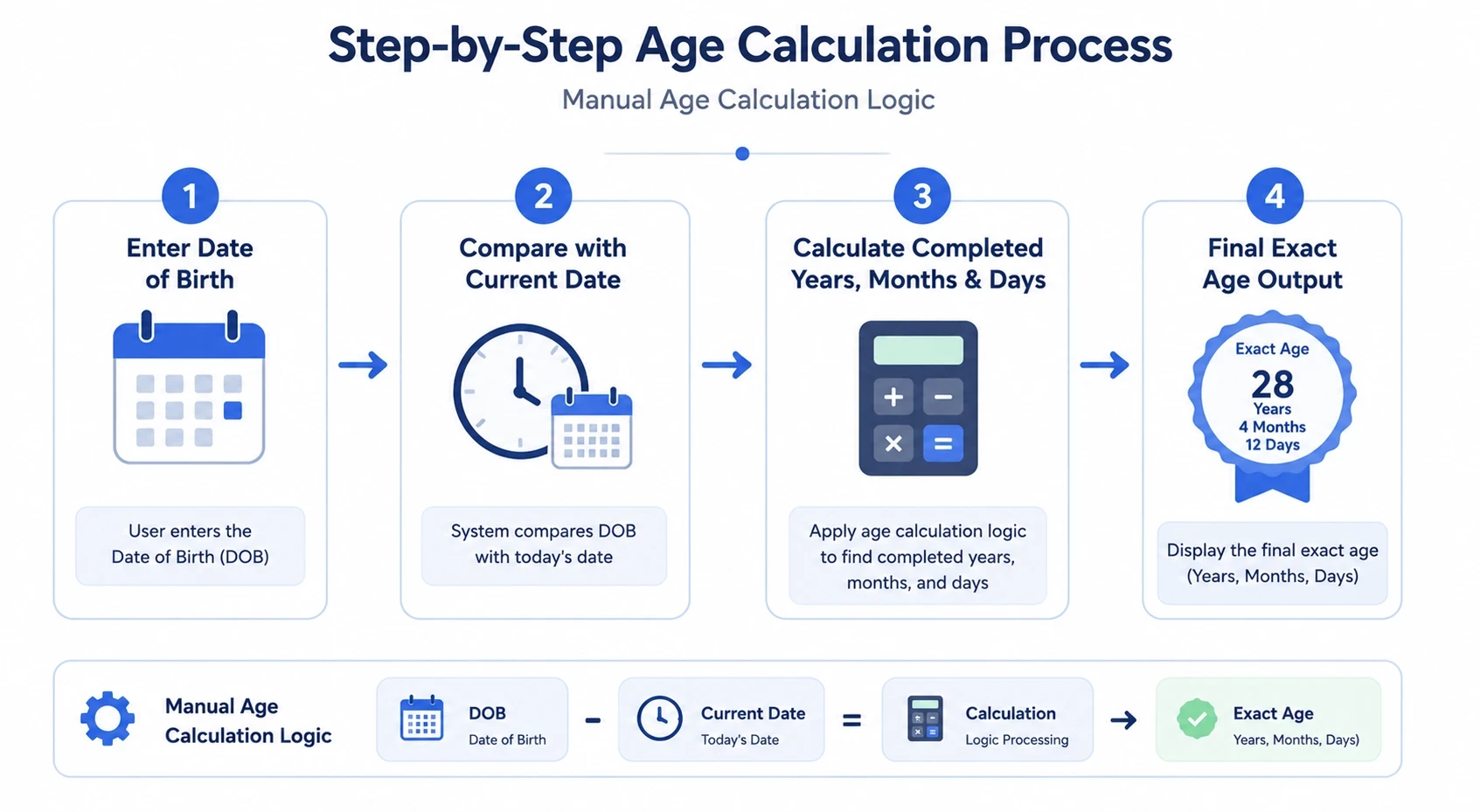
Take date of birth
Compare it with current date
Subtract years, months, and days
But in real systems, something subtle happens here.
These steps become much clearer when you understand the manual logic behind age calculation.
Related concept: How to Calculate Age Manually (Step-by-Step Guide).
Age is only counted when a full time cycle is completed.
For example:
If someone is born on 15 March 2000 and the current date is 10 March 2026, they are still 25 years old, even though the difference in years looks like 26.
This is where most confusion happens — people assume year difference equals age, but systems don’t work that way.
They wait for the exact completion of the birth date cycle.
Why Online Age Calculators Sometimes Show Different Results
This is one of the most misunderstood areas of age calculation—and honestly, this is where systems quietly differ from each other.
When two calculators show slightly different ages, it is usually not an error. There is a difference in interpretation.
This is where things stop being theoretical and start becoming system-dependent. Two calculators can both be correct yet still disagree.
These small differences are often caused by avoidable logic errors in system design.Related concept: Common Age Calculation Mistakes That Cause Wrong Results.
In real life, these differences are usually small, but they become noticeable when systems rely on strict date logic.
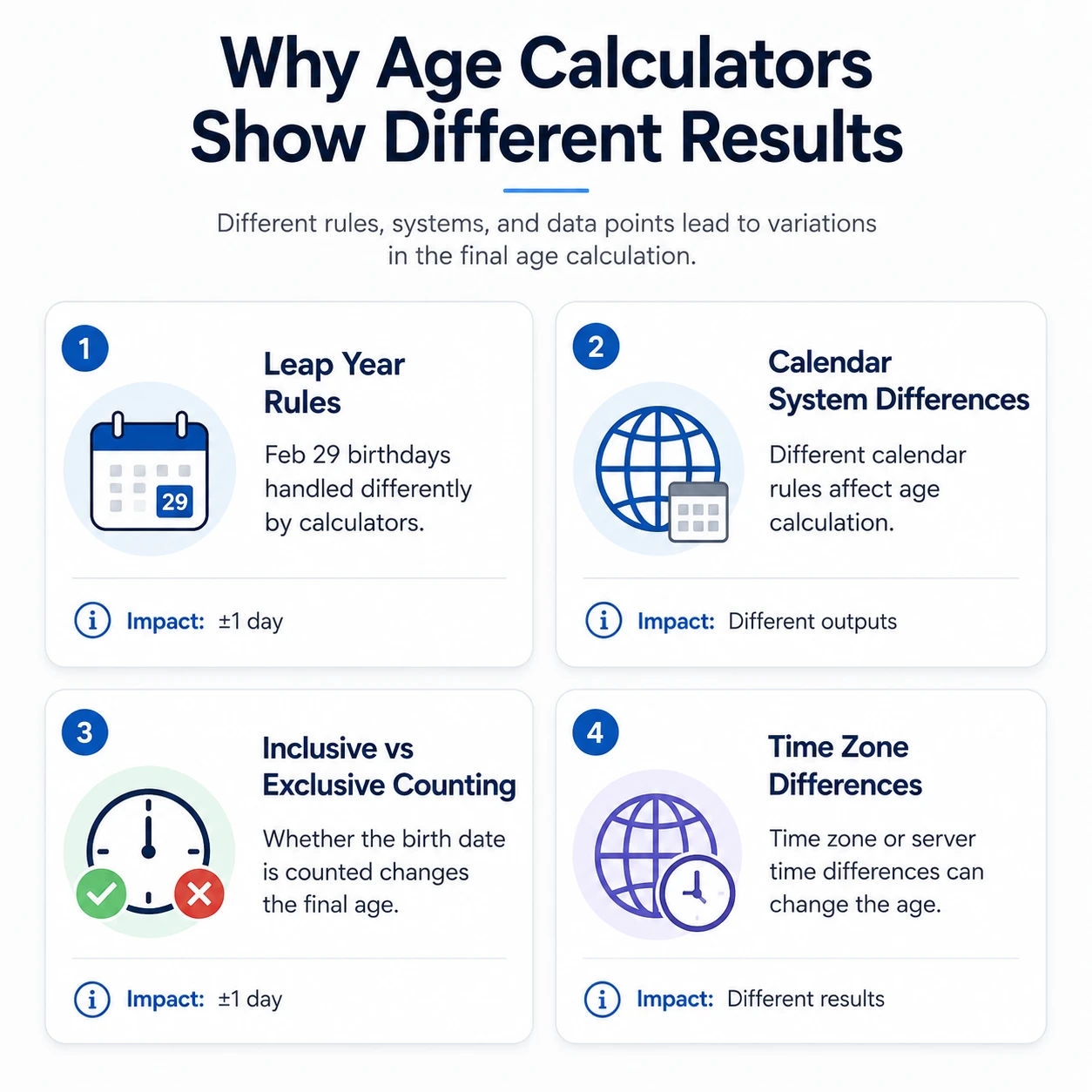
1. Leap Year Interpretation
Leap years introduce an extra day (February 29).
Now here’s the interesting part—not all systems treat this extra day the same way in long-term calculations.
What makes this tricky is that systems don’t just “add a day”—they adjust long-term alignment in different ways depending on internal logic.
In simple terms, this difference builds up slowly when extra leap days are handled differently across systems.
Leap years are one of the most common hidden reasons behind age differences in digital systems.
Related concept: How Leap Years Affect Age Calculation.
2. Calendar System Rules
Most systems follow the Gregorian calendar, but
Some apply strict rules
others simplify edge cases
And those small simplifications change results slightly.
In practice, calendar rules are not handled in a single universal way, which leads to slight variation in results.
For a deeper understanding of how this calendar system works, you can refer to the official explanation of the Gregorian calendar system.
3. Inclusive vs. Exclusive Counting
This is a subtle but powerful difference.
Some systems:
include the starting day
Others:
count only completed days
This alone can shift results by a small margin.
This is not obvious until you work with actual systems.
4. Time Zone Boundaries
Here’s something people almost never consider:
Time zones can affect results—and what’s interesting is that the same birth date can produce two slightly different outputs depending on where the system is calculating from.
UTC time
local system time
server time
This usually matters around midnight or when systems are based in different time zones.
In real-time environments, even server location can influence how date boundaries are interpreted.
Quick Comparison of Factors That Affect Age Calculation
Different Types of Age Calculations
Age is not always treated the same way everywhere—and this is where context matters more than math.
To understand how age differs beyond simple calendar logic, it helps to compare biological vs chronological perspectives.
Related concept: Chronological Age vs Biological Age : What’s the Difference?
1. Chronological Age
This is the most widely used form of age.
It is based purely on:
Time has passed since birth.
It is used in:
schools
jobs
legal systems
This is the “official age” most systems rely on.
2. Biological Age
Now this is where things shift from calendar logic to human biology.
Biological age reflects the following:
how the body is functioning compared to time
It is influenced by:
lifestyle
health condition
genetics
It is commonly used in:
medical research
fitness analysis
longevity studies
Real-World Scenarios Where Age Calculation Actually Matters
Instead of being a clean category system, age calculation behaves differently depending on the situation—and in many cases, small differences matter more than people expect.
A hospital scenario
In medical systems, age is not treated as a number but as a condition boundary. A newborn who is just a few days younger may receive a completely different dosage recommendation because treatment rules are tied to exact age, not approximation.
This is where systems become extremely strict, because even a small time difference can shift medical classification rules.
A school admission scenario
In education systems, cutoff dates silently decide outcomes. Two children born just a few days apart may end up in different grades — not because of ability, but because systems rely on strict date boundaries.
What most people don’t realize is that these cutoff rules matter more than actual ability in early placement systems.
A legal eligibility scenario
Legal systems are even stricter. Eligibility for voting or driving is not based on being “almost 18”—it is based on exact completion of age. Even a single missing day can entirely change legal status.
This is one of the clearest examples where age is treated as a strict boundary, not a gradual number.
A workplace or insurance scenario
In employment and insurance systems, age becomes a classification tool. A small difference in calculated age can influence retirement eligibility, insurance pricing, or risk category assignment.
How Modern Age Calculators Work (Real Logic Explained)
Now let’s go slightly deeper, but in a practical way.
Modern systems don’t “guess” age. They calculate it using structured logic.
For a technical breakdown of how computers handle date and time calculations, you can refer to how programming date systems work in real applications.
1. Gregorian Calendar System
Most calculators rely on the Gregorian calendar because it standardizes the following:
month lengths
leap year rules
yearly structure
2. Date Difference Logic
Instead of subtracting numbers, systems calculate the following:
completed years
remaining months
remaining days
This is where most people expect simple subtraction — but systems never work that way in practice.
This is why age is always "structured," not linear.
3. Leap Year Adjustment
Every four years, February gets an extra day.
This is automatically handled in systems, but here’s the key insight:
👉 It affects long-term alignment, not just single-year calculation.
4. Time Boundary Processing
Advanced systems also consider:
system time
server time
timezone differences
midnight boundaries
This is why the same input can behave slightly differently in different environments.
FAQs
Age calculation works by measuring the time between your date of birth and a reference date.
Instead of simple subtraction, systems only count fully completed years, months, and days based on calendar rules.
Age calculators may differ because they use different rules for leap years, time zones, and partial-day handling. These small variations can slightly change results even when the same birth date is used.
Your exact age is calculated by counting completed years from your date of birth, then calculating remaining months and days based on the current date. It reflects only fully completed time cycles, not approximate values.
Leap years add an extra day (February 29) every four years, which is included in calendar systems. This slightly adjusts long-term age calculations by affecting total day counts across years.
Yes. This can happen due to differences in time zones, system clocks, or server time. Even though the birth date is the same, calculation timing can create small variations in exact age.
Age calculation is more complex because calendar time is uneven. Months have different lengths, and leap years add extra days. Systems calculate completed time cycles instead of directly subtracting numbers.
No. Most systems follow the Gregorian calendar, but legal and administrative age rules can differ between countries depending on local policies for eligibility and documentation.
Conclusion
At first glance, age calculation feels very simple. But once you look closely, you realize it’s actually based on how calendars measure time and how systems decide when a year or month is truly completed.
The key thing to understand is this:
👉 Small differences in age results are not mistakes—they come from different ways systems interpret time.
Once this clicks, it becomes much easier to understand why different tools sometimes show slightly different ages for the same date of birth.
In the end, age is just a practical way of measuring time passed since birth, shaped by the rules of the system being used. And when you understand those rules, the results stop feeling confusing and start making sense.