Online Scientific Calculator: Understanding Advanced Mathematical Calculations (Complete Guide for Students & Professionals)
- Published: Dec 04, 2025
- Last updated: Jun 08, 2026
- Calculating reading time...
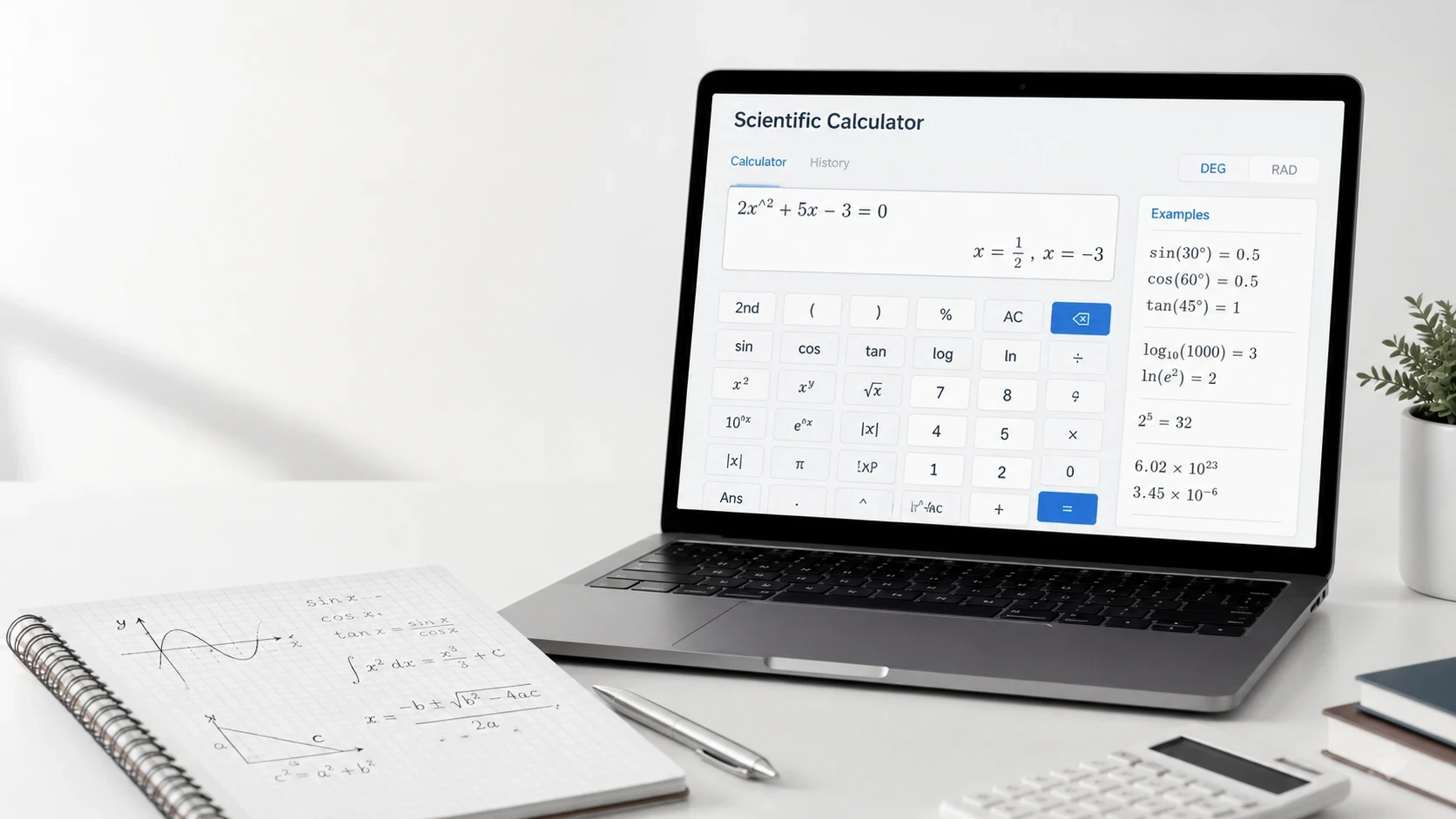
An online scientific calculator allows students and professionals to solve mathematical problems such as trigonometry, algebra, logarithms, exponents, and scientific notation directly in a web browser. It removes the need for installing physical software or relying on advanced hardware devices, making it highly accessible for academic and professional use.
Many learners initially struggle with scientific calculations, especially when dealing with complex expressions or switching between mathematical modes. A common example is incorrect use of angle settings such as degrees and radians in trigonometry, which can produce wrong answers even when the formula is correct.
Understanding how these calculations work is more important than simply using a tool, especially in subjects like mathematics, physics, and engineering where accuracy depends on correct interpretation of formulas and values.
What Is an Online Scientific Calculator?
An online scientific calculator is a web-based mathematical tool designed to solve higher-level calculations used in science, mathematics, and engineering. For deeper mathematical background on trigonometry concepts, see trigonometry introduction and unit circle concepts. It is capable of handling expressions involving algebra, trigonometry, logarithms, exponents, and scientific notation.
Unlike basic calculators that focus on simple arithmetic, this calculator is built to support structured mathematical problem-solving required in technical and academic fields.
Key Comparison: Basic vs. Online Scientific Calculator

If you want a clear breakdown of differences, read the detailed comparison of basic vs scientific calculator to understand real-world usage differences.
Why Online Scientific Calculators Are Useful in Study
In academic learning, students deal with different mathematical formats such as degrees, radians, equations, and scientific expressions. Understanding and applying these formats correctly is an important part of developing strong mathematical skills.
An online scientific calculator helps students interpret mathematical expressions more clearly and apply formulas in a structured way during practice. This is especially helpful in subjects like algebra, trigonometry, physics, and engineering, where problem setup is often more important than final calculation.
It also supports learners in building confidence by reducing confusion in multi-step problems and allowing them to focus more on how mathematical expressions are formed and solved.
What These Calculations Are Used For in Real Study
In mathematics and science education, different types of calculations are applied to solve structured academic problems rather than simple numerical operations. These tools help students apply these concepts more efficiently during practice and learning.

Algebra
Used to verify expressions and understand how equations are simplified step by step. This helps in building pattern recognition in mathematical formulas.Trigonometry
Used for angle-based functions such as sine, cosine, and tangent, which are widely applied in physics, geometry, and engineering.Logarithms & Exponents
Used to represent growth, decay, and scaling systems in advanced mathematics and science.Scientific Notation
Used to handle extremely large or very small values in fields like physics and chemistry.These concepts are often applied together in real academic problem-solving rather than being used in isolation.
Final Insight
Overall, these calculations are not just tool-based functions but essential parts of academic learning, where online scientific calculators act as support systems for accuracy, verification, and more profound understanding.
Overall, such calculators strengthen learning by improving accuracy, reducing manual effort, and supporting structured mathematical thinking.
How Does an Online Scientific Calculator Work?
An online scientific calculator works by taking a mathematical input, understanding the structure of the expression, and then processing it using built-in mathematical rules to produce an accurate result.
When a user enters a value or equation, the system identifies the type of operation involved, such as arithmetic, trigonometric, or logarithmic calculations. It then applies the correct mathematical logic in the background to generate the solution automatically.

This process allows even complex expressions to be solved quickly without manual step-by-step calculations. By automating mathematical rules, such calculators reduce human error and improve accuracy in advanced problem-solving.
This structured process ensures consistency in results across different types of mathematical operations.
For a deeper understanding of reliability and precision, you can explore how accurate online scientific calculators are in real academic and professional use.
How to Use a Scientific Calculator online
If you are new to mathematical calculators, it is important to understand the thinking process behind solving problems, rather than focusing only on buttons or functions.
In most academic work, the process begins by identifying the type of problem—such as algebra, trigonometry, logarithms, or scientific notation. Once the structure of the expression is clear, the correct mathematical approach can be applied.
A very important factor in trigonometry-based problems is selecting the correct mode, such as degrees or radians. A wrong setting can entirely change the final result, even if the formula is correct.
Instead of focusing on manual steps, students benefit more by understanding how expressions are formed and interpreted. This makes problem-solving more accurate, especially in physics and mathematics where multi-step equations are common.
You can practice this directly using our online scientific calculator for real-time calculations and learning support.
📌 Key Idea:
The focus is not on performing steps manually, but on understanding how mathematical expressions are structured and interpreted.
Try Online Scientific Calculator Now
Common Mistake Students Make in Trigonometry
One of the most common mistakes in trigonometry is using the wrong angle mode, such as degrees vs. radians.
This type of error is explained in detail in common scientific calculator mistakes beginners make, where students often lose marks due to small but critical calculation errors.
For example, when solving sin(45°), the correct interpretation depends on selecting the proper mode.
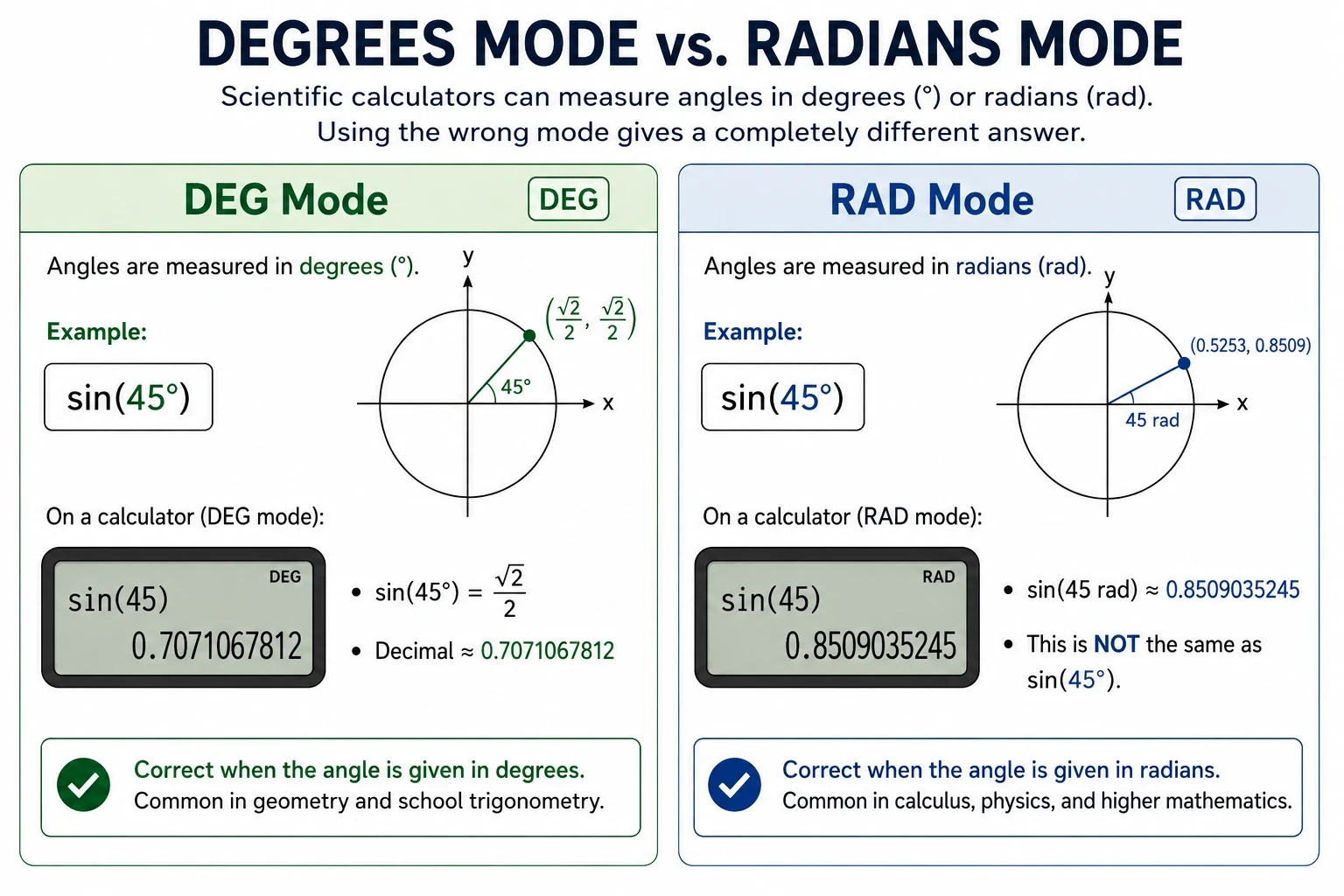
If the calculator is set to radians instead of degrees, the result will be incorrect even if the formula is entered correctly.
This mistake highlights an important concept: in mathematics, accuracy depends not only on formulas but also on correct interpretation of settings and conditions.
Solving Algebra and Trigonometry in a Structured Way
In algebra and trigonometry, solving problems is not only about performing calculations but also about understanding the structure of the expression itself.
Complex problems are often easier to solve when broken into smaller logical parts. This approach helps in identifying patterns, simplifying expressions, and reducing errors during calculation.
In algebra, this involves recognizing terms, simplifying expressions, and solving equations step by step. In trigonometry, it focuses on understanding angle relationships and applying the correct identities based on the structure of the problem.
Rather than replacing learning, calculators support this process by helping verify results and improving accuracy during practice and revision.
Understanding Sin, Cos, and Tan in Trigonometry
Trigonometric functions such as sine, cosine, and tangent are used to study relationships between angles and sides in mathematics and physics.
To better understand how these functions work in calculations, see scientific calculator functions like sin, cos, log and ln explained in a simple breakdown.
In practical learning, these functions require careful attention to how angles are interpreted in a problem, since the same mathematical value can produce different results depending on whether degrees or radians are used.
The main challenge for students is not performing the calculation itself, but correctly understanding the structure of the trigonometric expression and applying the right mathematical setup.
By focusing on how angles relate to formulas in trigonometry, learners can improve accuracy and reduce common mistakes in academic problem-solving.
Correct interpretation of angle context is more important than memorizing trigonometric values.
Working With Complex Equations in Mathematics
In higher-level mathematics, many problems involve multiple operations combined within a single expression. These are known as complex equations.

Such expressions require careful attention to structure, including brackets, powers, and the correct order of operations. Small mistakes in structure can completely change the final result.
In fields like physics, engineering, and advanced mathematics, these equations are commonly used to represent real-world systems and mathematical models. You can explore a detailed academic explanation of these concepts here: overview of trigonometric ratios and identities.
Understanding the structure of an equation is often more important than solving it directly, as it helps improve accuracy and problem-solving ability in multi-step calculations.
Order of operations and structural clarity determine the correctness of complex mathematical expressions.
Who Can Use an Online Scientific Calculator?
A scientific calculator is widely used in different educational and professional fields where mathematical problem-solving is required.
In school-level education, it supports learning algebra, trigonometry, and basic scientific concepts by helping students understand how formulas work in practice.
In science subjects such as physics and chemistry, it is commonly used for solving equations involving angles, measurements, and scientific notation.
In technical and engineering fields, it assists with complex formulas, conversions, and structured numerical calculations that require both accuracy and efficiency.
It is also useful in teaching environments, where it helps explain mathematical concepts and verify solutions during instruction.
Overall, such calculators support anyone working with structured mathematical problems by improving accuracy and simplifying complex calculations.
📌 Summary:
These calculators are not limited to students but are widely used in academic, technical, and professional environments where structured calculations are required.
Logarithms and Scientific Notation
Logarithms and scientific notation are important mathematical concepts used in advanced mathematics, physics, and engineering to represent very large or very small numbers in a simplified format.
In academic practice, logarithmic functions such as log and ln are used to solve equations involving growth, decay, and exponential relationships.
Scientific notation is commonly used to express extremely large or small values in a standardized form, especially in scientific fields like physics and chemistry.
For a clearer understanding of scientific notation with step-by-step examples, you can refer to scientific notation explained with examples.
An online scientific calculator helps support these calculations by allowing users to focus on understanding the concept rather than handling complex manual computation.
Additional Mathematical Support
An online scientific calculator is not limited to basic or academic learning tasks; it is also useful in handling repeated and time-consuming calculations efficiently.
It can be used for simplifying expressions, working with scientific values, solving percentage-based problems, and handling structured equations that appear frequently in practice or professional work.
In classrooms, it helps students check their answers and understand solving patterns, while in technical and professional environments, it supports quick calculation handling where repeated computation is required.
This makes it especially practical for situations where the same type of calculation needs to be performed multiple times with consistent results.
FAQs
📌 Final Note:
Online scientific calculators are designed to simplify learning and improve accuracy in mathematical problem-solving across multiple disciplines.
Conclusion
An Online Scientific Calculator plays an important role in modern education by supporting structured mathematical problem-solving across subjects like algebra, trigonometry, physics, and engineering.
Instead of replacing learning, it works alongside traditional methods by helping users apply formulas more effectively and check their understanding during practice.
Because it is accessible through a browser, it can be used across different devices, making it suitable for both classroom learning and real-world applications.
Overall, it acts as a practical bridge between learning mathematical concepts and applying them in real situations.
Start Solving with Online Scientific Calculator
📌 Final Insight:
The real value of an online scientific calculator lies in connecting mathematical understanding with practical application in study and professional use.